Miles away from the foggy mornings, overcast afternoons, and chilly evenings of July in the Bay Area is the sun-warmed island of Key West, Florida, where the white sand, crystal-clear waters, and laid-back pace invite you to relax and enjoy a moment of quiet tranquility.
These moments are the ones chosen by Cuban American folk artist Mario Sanchez (1908–2005) to immortalize in his charming and singular relief panels. Sanchez was born and raised on the island, working from his home studio for over 70 years and creating a treasury of everyday scenes that harken back to a simpler time. Sanchez’s colorfully painted and carved reliefs depict landmarks like the Hemingway House and the 150-year-old lighthouse, a waterfront bait-and-tackle shop, well-loved bungalows, palm trees, and of course, the unique characters of Old Key West.
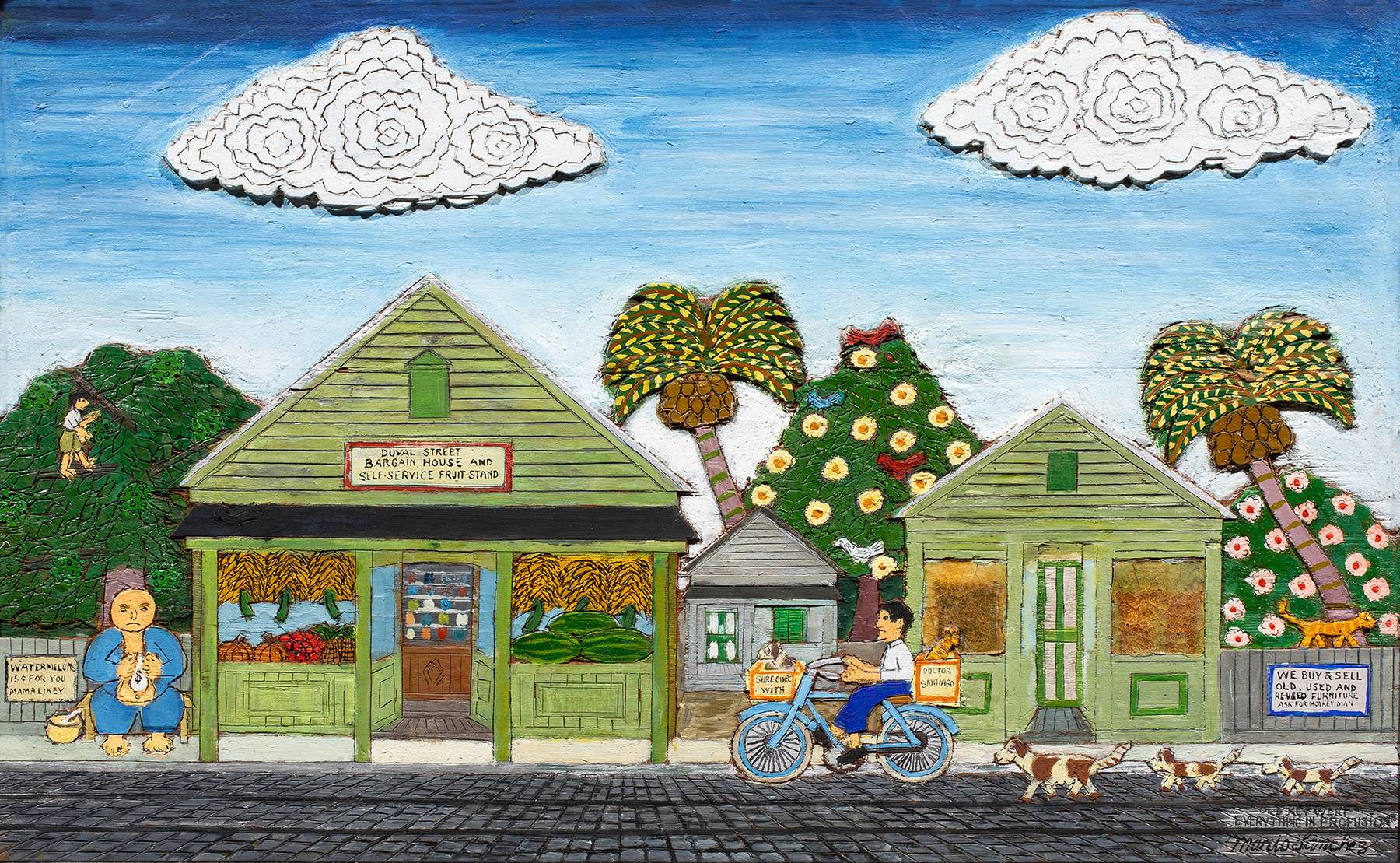
Mario Sanchez (American, 1908–2005), Old Key West – Everything in Profusion, oil on carved and painted wood relief, 16.25″ x 26.25″. Estimate: $20,000–$40,000
The brightly colored panel in our July auction, titled Old Key West – Everything in Profusion, shows a section of Duval Street, a main thoroughfare of the town and the center of local Cuban influence, where a fruit stand is packed with bananas and watermelons. A bicyclist pedals past, his baskets reading “Sure Cure with Doctor Santiago,” and a trio of floppy-eared dogs follow behind. The blue sky overhead, decorated with Sanchez’s signature fluffy clouds, and the vibrant hues of the flowering plants imbue the scene with a peaceful energy. This highly collectible piece of history from the United States’ southernmost city is the centerpiece of your beach house, the reminder of a fabulous vacation, or your ray of sunshine on a cloudy day. Old Key West – Everything in Profusion is estimated at $20,000–$40,000.
Annie Leibovitz began her artistic career at the San Francisco Art Institute in the late 1960s, where she originally studied painting but was inspired to change her focus to photography.
This May 15th, Clars is excited to offer an outstanding oil on canvas painting by artist Raimonds Staprans.
Artist Spotlight
Modern + Contemporary Art
Annie Leibovitz: A Portrait of American Life Through the Camera Lens
Artist Spotlight
Modern + Contemporary
The Making of a Photographer
Born on October 2, 1949, in Waterbury, Connecticut, Annie Leibovitz grew up in a military family that moved frequently across the United States. It was this itinerant upbringing, and an early habit of recording places and faces she feared losing, that first drew her to image-making. She enrolled at the San Francisco Art Institute in the late 1960s, intending to study painting, but a darkroom class changed everything. Within a short time, photography had become her primary language.
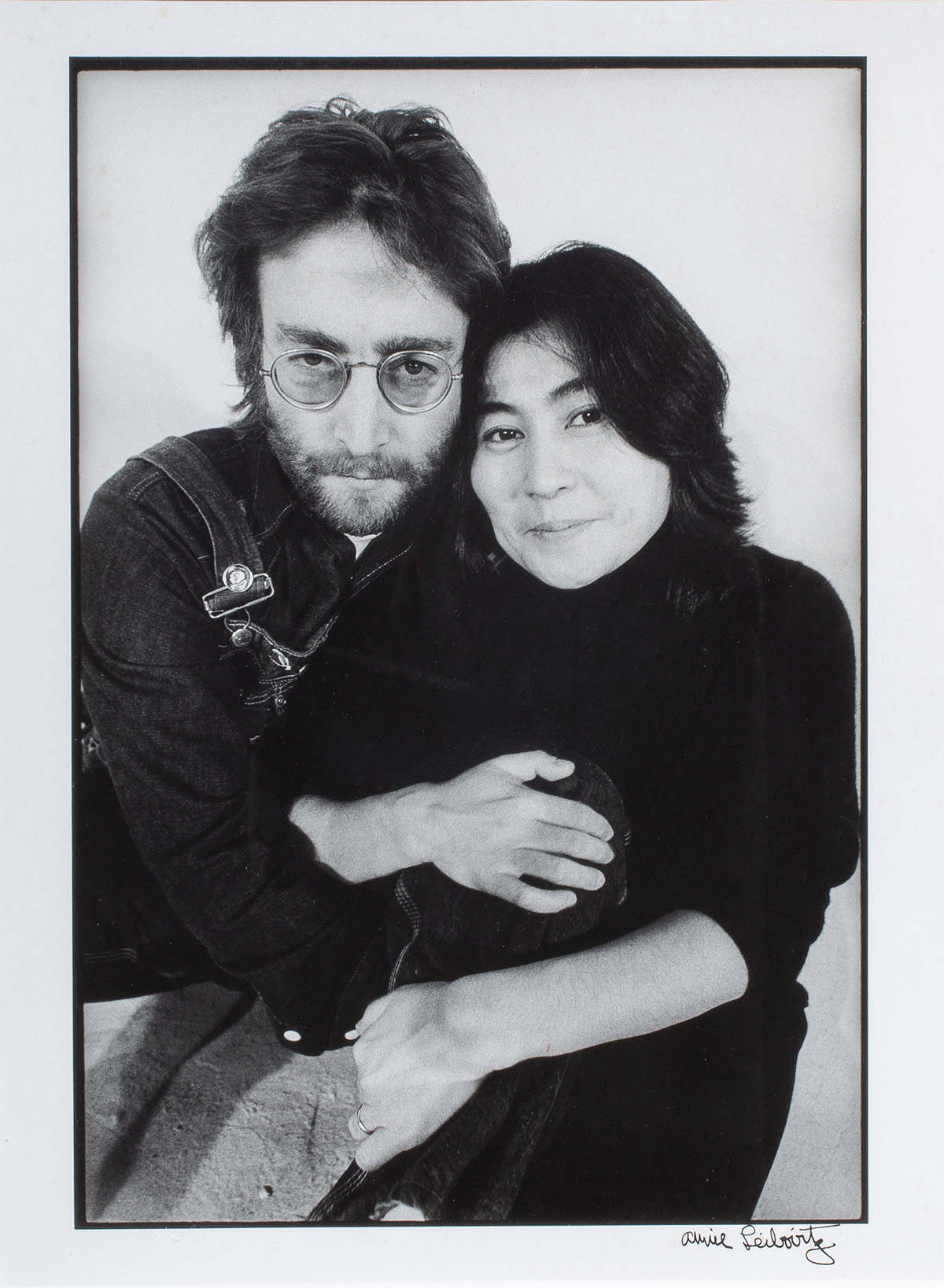
Annie Leibovitz (American, b. 1949), John Lennon and Yoko Ono, 1970, gelatin silver print, 11″ x 7.5″. Sold: $6,300
In 1970, at 21, Leibovitz walked into the offices of Rolling Stone magazine in San Francisco with a portfolio of photographs. Jann Wenner, the magazine’s founding editor, was struck by what he saw and gave her an assignment immediately. Her first published photograph ran on the cover of Rolling Stone in January 1971: a portrait of John Lennon taken during a session that would become one of the defining moments of her early career. She was hired as a staff photographer, and by 1973 had been named the magazine’s chief photographer, a title she held until 1983, during which time she produced some of the most memorable celebrity portraiture of the era.
The thirteen years she spent at Rolling Stone established the visual grammar that would define her reputation. She photographed musicians, actors, athletes, and politicians with an intimacy that felt genuinely earned rather than performed. Her subjects included the Rolling Stones on tour, Patti Smith, Bruce Springsteen, Arnold Schwarzenegger, and Bette Midler. Her approach was immersive: she would spend extended time with subjects, often traveling with them, building enough trust that the camera seemed to disappear. The resulting photographs felt less like posed portraits and more like brief, honest glimpses into private lives.
Vanity Fair, Vogue, & the Portrait at Scale
In 1983, Leibovitz transitioned to Vanity Fair, where she would spend the next several decades producing work that would extend and deepen her reputation. The editorial budgets and production scale available at Vanity Fair allowed her to realize increasingly ambitious visual concepts. Her portraits from this period are among the most widely reproduced magazine images in American publishing history: Demi Moore, visibly pregnant, photographed nude on the August 1991 cover; Whoopi Goldberg submerged in a bath of milk; a reclining Keith Haring covered in body paint. These images were not simply photographs; they were cultural events.
Alongside her editorial work for Vanity Fair, Leibovitz has contributed extensively to Vogue, photographing fashion campaigns and portraits for both the American and international editions. Her advertising clients have included American Express, Honda, and Louis Vuitton. The latter campaign, which featured major cultural figures, including Mikhail Gorbachev, Catherine Deneuve, and Keith Richards, in travel settings, became one of the most celebrated advertising series of the 2000s.
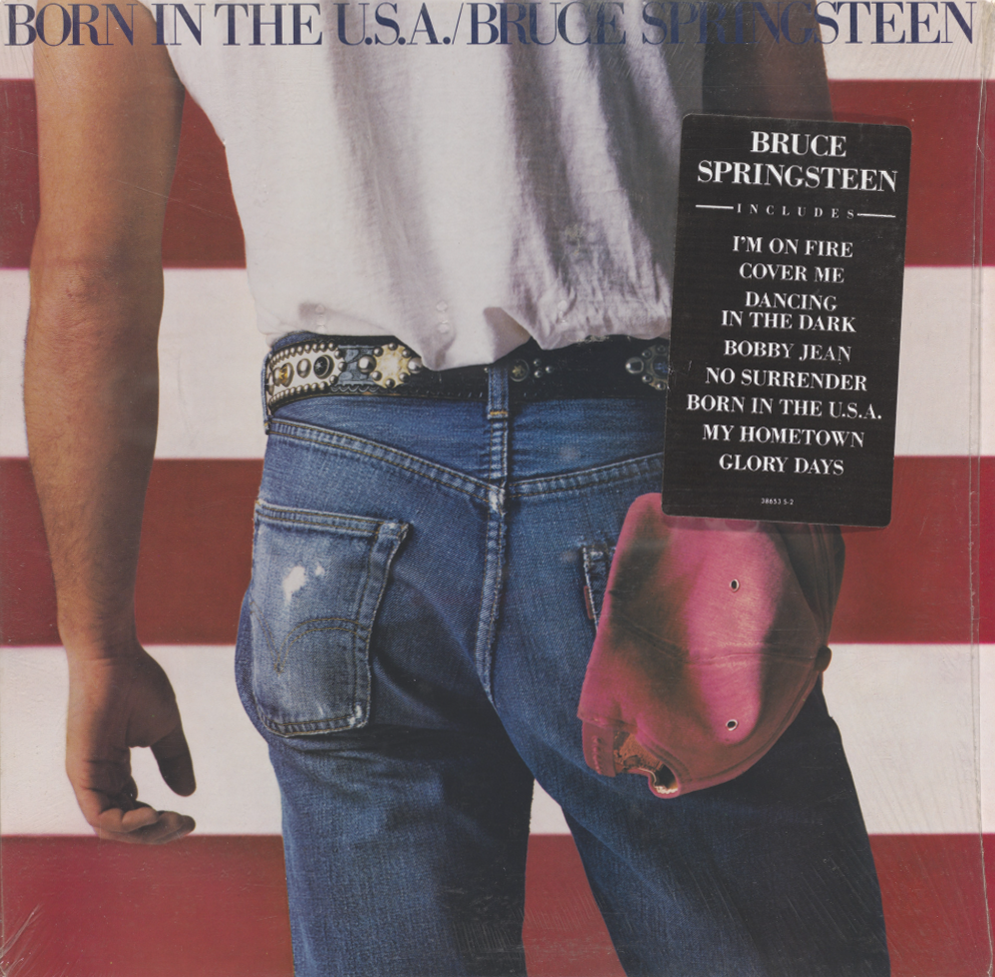
Andrea Klein, Annie Leibovitz, Album cover for Bruce Springsteen, Born in the U.S.A., 1984. Source: Museum of Modern Art
December 8, 1980, produced what many consider the most significant single photograph of her career. In the hours before John Lennon’s assassination, Leibovitz photographed him curled around Yoko Ono in their Dakota apartment. The image, a nude Lennon in fetal embrace around a fully clothed Ono, ran on the cover of Rolling Stone following his death and has since become one of the most iconic photographs of the twentieth century. Leibovitz was the last professional photographer to photograph Lennon alive.
Museum Recognition & Institutional Legacy
In 1991, Leibovitz became the first woman to stage a solo exhibition at the National Portrait Gallery in London. The show, drawn from two decades of portraiture work, established her within a tradition of formal portraiture that extended well beyond magazine photography. The accompanying monograph, Photographs: Annie Leibovitz 1970–1990, remains a key reference for collectors and researchers.
Subsequent exhibitions have included Women (1999), a collaboration with writer Susan Sontag featuring portraits of women from diverse backgrounds and professions; American Music (2003), which documented musicians across genres; and A Photographer’s Life: 1990–2005, which originated at the Brooklyn Museum before traveling internationally. That exhibition was significant for its candor; it interwove professional editorial work with deeply personal photographs documenting the final years of Susan Sontag’s life and the early childhood of Leibovitz’s daughters.
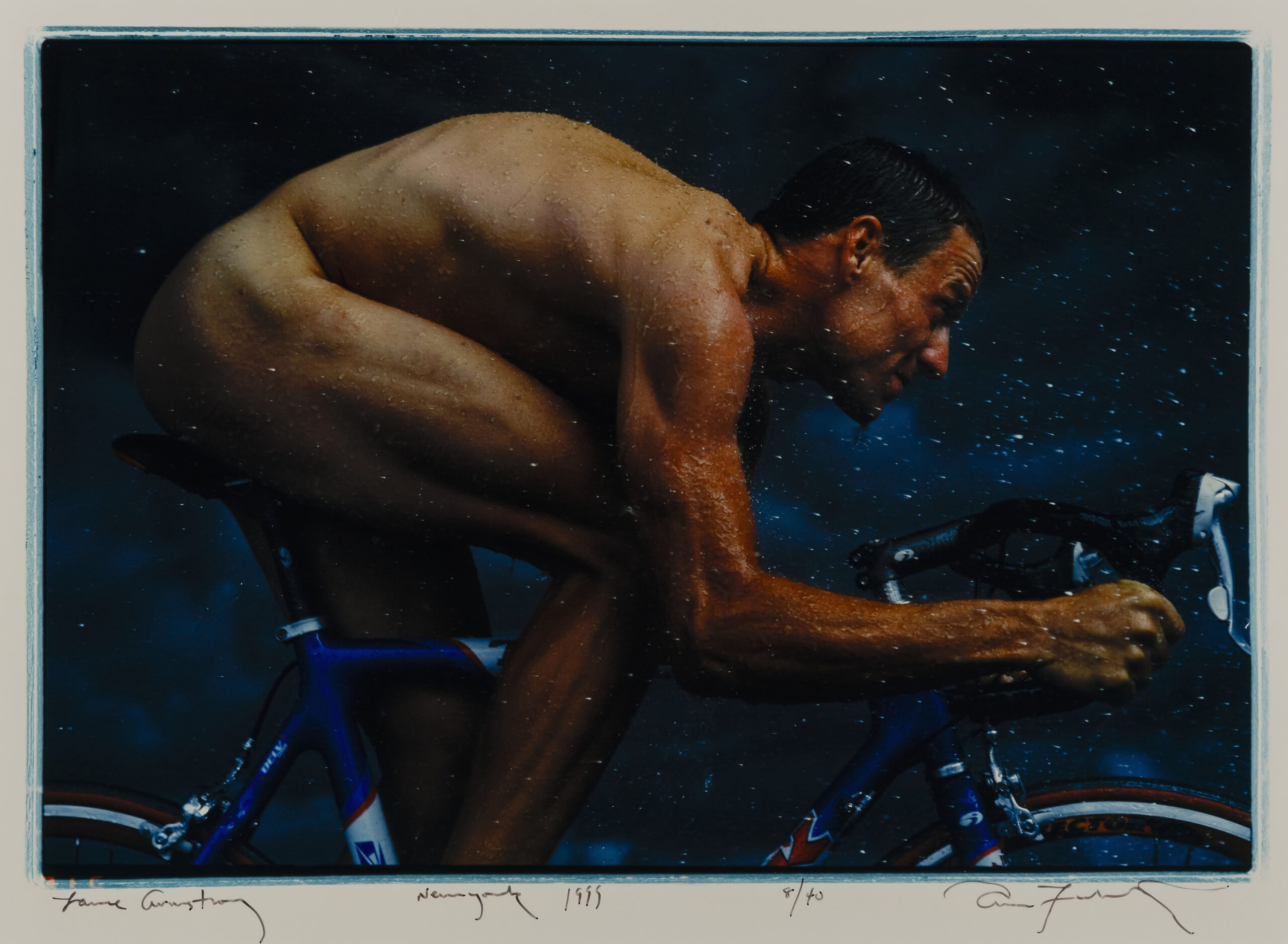
Annie Leibovitz, Lance Armstrong, 1999, chromogenic print, 11.75″ × 17″. Source: Smithsonian American Art Museum
Her work is held in the permanent collections of major institutions, including the Museum of Modern Art in New York, the Art Institute of Chicago, the National Portrait Gallery in London, and the Smithsonian American Art Museum. In 2006, she was named a Living Legend by the Library of Congress. She is currently represented by Hauser & Wirth, one of the world’s leading contemporary art galleries, a relationship that situates her work firmly within the contemporary fine art market rather than solely within the world of editorial photography.
Her Most Iconic Photographs
A handful of images have come to define Leibovitz’s public identity as a photographer:
John Lennon and Yoko Ono (1980) — Taken hours before Lennon’s assassination, this gelatin silver print is among the most reproduced photographs of the twentieth century.
Demi Moore, Pregnant (1991) — The Vanity Fair cover that redefined how pregnancy was represented in mainstream media and generated international debate.
Whoopi Goldberg in a Milk Bath (1984) — A conceptually daring image that remains among her most discussed early works.
Keith Haring with Body Paint (1986) — A collaboration that merged the visual languages of two distinct artistic practices.
Queen Elizabeth II (2007) — Commissioned portraits taken at Buckingham Palace, which generated significant press coverage and became landmarks of official royal portraiture.
Caitlyn Jenner (2015) — The Vanity Fair cover that generated the magazine’s highest newsstand sales in decades.
These images are not simply well-known. They occupy a specific place in the broader history of photography as a medium capable of shaping public perception, reframing cultural narratives, and functioning as historical documents of their moment.
Collecting Leibovitz: What to Know
For collectors interested in acquiring work by Annie Leibovitz, understanding the structure of her market is essential. Her photographs exist in several distinct formats, and the format, print date, and edition size all have a direct bearing on value.
Print Formats & Media
Leibovitz’s photographs are produced in three primary media:
Gelatin silver prints: The traditional photographic medium used for her black-and-white work from the Rolling Stone era and beyond. Vintage gelatin silver prints — those produced at or near the time the photograph was taken — are the most sought after by serious collectors and carry a premium over later editions.
Chromogenic (C-print) prints: Used for her color photography, particularly the Vanity Fair and Vogue work. These are typically available in limited editions and represent the most accessible tier of her market for collectors entering at a mid-range price point.
Digital inkjet (pigment) prints: Used for more recent work and large-format editions. These prints are often produced in very small editions and are associated with her gallery representation through Hauser & Wirth.
Edition Size & Print Date
Edition size matters significantly in Leibovitz’s market. Smaller editions command higher prices; a print issued in an edition of five will typically outperform one issued in an edition of fifty, all else being equal. Print date is equally important: vintage prints, those produced close to the time the photograph was taken, consistently achieve stronger results at auction than later reprints, even of the same image. Collector preference for vintage prints reflects the historical and material authenticity of the object rather than the image alone.
Provenance also plays a meaningful role. Prints that can be documented to private sales through Hauser & Wirth or major photography galleries, or that carry exhibition history, are generally more desirable to institutional buyers and serious private collectors.
Price Ranges at Auction
The market for Leibovitz photographs spans a wide range. At the entry level, signed prints from later editions, particularly color work from the 1990s and 2000s, have sold at auction for low thousands. Mid-tier examples, particularly vintage gelatin silver prints of iconic subjects, typically realize between $5,000 and $30,000. Major works — large-format prints, unique or near-unique vintage examples, and images with significant cultural resonance — have reached six figures at major auction houses. The John Lennon and Yoko Ono gelatin silver print from 1970 is among the most actively traded of her works, with realized prices at auction varying based on print date, size, and condition.
Collectors new to photography will find useful context in Clars’ fine art photography department, which handles a range of vintage and contemporary photographic works across price points.
Annie Leibovitz at Clars Auctions
Clars Auctions has handled Annie Leibovitz’s work at auction, including a gelatin silver print of John Lennon and Yoko Ono (1970), measuring 11″ × 7.5″ and signed, which sold for $6,300. The print originated from the same session in which Leibovitz captured Lennon for what would become the January 1971 cover of Rolling Stone, one of the pivotal early milestones of her career.
Works by Leibovitz appear at auction infrequently relative to collector demand, particularly vintage prints of her most recognized subjects. When they do come to market, they tend to attract sustained interest from collectors building collections in American photography, modern portraiture, and twentieth-century cultural history.
For Buyers
If you are building a collection in American photography or fine art portraiture, we recommend reviewing our auction calendar and live catalogs to stay informed when a Leibovitz work enters one of our sales. Our team of fine art specialists is also available to assist with research and pre-sale inquiries.
New to the auction process? Our guide for first-time bidders walks you through registration, bidding options, and what to expect on sale day. You can also explore ways to buy, including absentee and telephone bidding.
For Sellers
If you own a work by Annie Leibovitz — whether a vintage print, a signed later edition, or a large-format gallery work — Clars Auctions is well-positioned to help you understand its current market value and bring it to the right buyers. Our specialists provide professional appraisals for fair market, insurance, and estate purposes, and our established presence in fine art and photography auctions means your consignment reaches a targeted, qualified collector base.
Marion Kavanaugh Wachtel beautifully captures the vibrant transformation of the leaves in the foothills of California.
Artist Spotlight
Fine Art
Aaron Douglas: The Making of a Movement’s Visual Voice
Artist Spotlight
Modern Art
The Artist Who Defined the Visual Identity of the Harlem Renaissance
When Aaron Douglas arrived in New York City in 1925, he had planned to keep moving, and Paris was the destination, as it was for so many artists of his generation. He never made it. What he found in Harlem was something more urgent: a cultural awakening in full swing, and a community of writers, thinkers, and artists who recognized in him exactly what they needed. Douglas stayed and, in doing so, became the defining visual chronicler of the Harlem Renaissance.
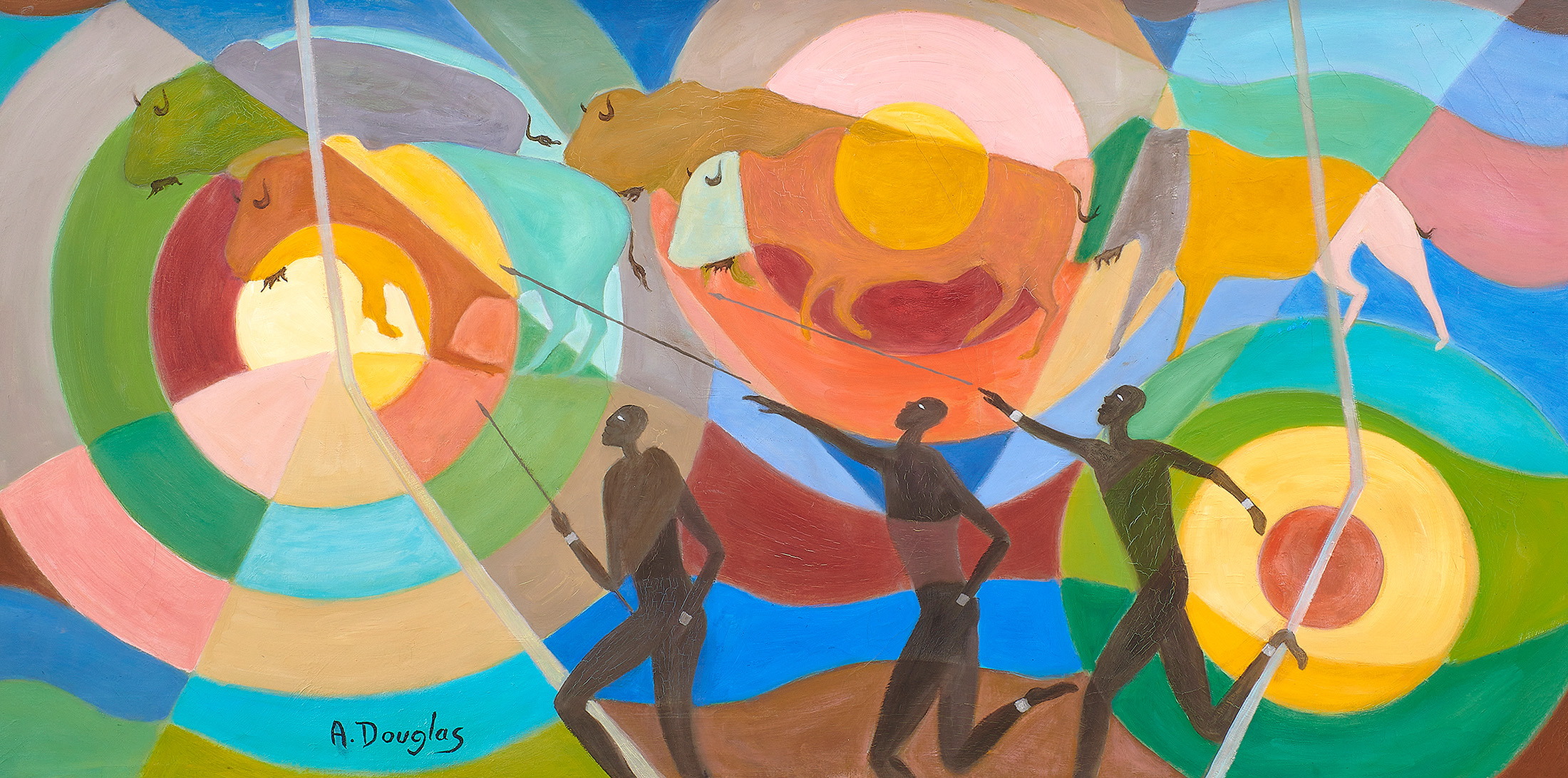
Aaron Douglas (American, 1899–1979), Untitled, circa 1955, oil on canvas, signed lower left, 22″ x 44″. Sold: $10,710
Born in Topeka, Kansas, on May 26, 1899, Douglas came to art with both formal training and personal conviction. He earned his fine arts degree from the University of Nebraska in 1922, taught in Kansas City, and arrived in Harlem already serious about his craft. Under the mentorship of German portraitist Winold Reiss, he was pushed toward something more daring, a visual language rooted in African artistic traditions that could speak directly to the Black American experience. Douglas embraced the challenge fully, and what emerged was a style unlike anything in American art at the time.
A Style Built to Last
What makes Aaron Douglas’ paintings immediately recognizable is the deliberate tension between simplicity and complexity. His figures are rendered as flat silhouettes, stripped of individual features, yet radiating collective power. He layered concentric rings of light behind his subjects, a signature compositional device that gave his scenes an almost spiritual luminosity. Color was handled with restraint: muted earth tones, dusky blues and greens, punctuated by sharp gradients that suggested both sunlight and searchlights.
These choices weren’t aesthetic accidents. Douglas was synthesizing multiple art historical traditions simultaneously — the geometric rigor of Cubism, the decorative clarity of Art Deco, and the narrative conventions of ancient Egyptian wall painting — and filtering them through the rhythms of jazz, the imagery of the African continent, and the daily realities of Black life in America. The result was a visual vocabulary that felt both ancient and completely modern. It became, as scholars have noted, the aesthetic signature of the Harlem Renaissance itself.
His figures inhabit two worlds with equal fluency. In some works, they move through abstracted African landscapes, spear in hand, surrounded by dense foliage, beneath vast skies. In others, they navigate the urban North: playing brass instruments in jazz clubs, operating industrial machinery, marching against city skylines. Across both settings, the message is the same: people with deep roots, in motion, asserting their place in history.
Aaron Douglas’ Most Significant Accomplishments
Douglas was not simply a studio painter. He was a public artist in the fullest sense, and his most celebrated works were made for walls, not galleries.
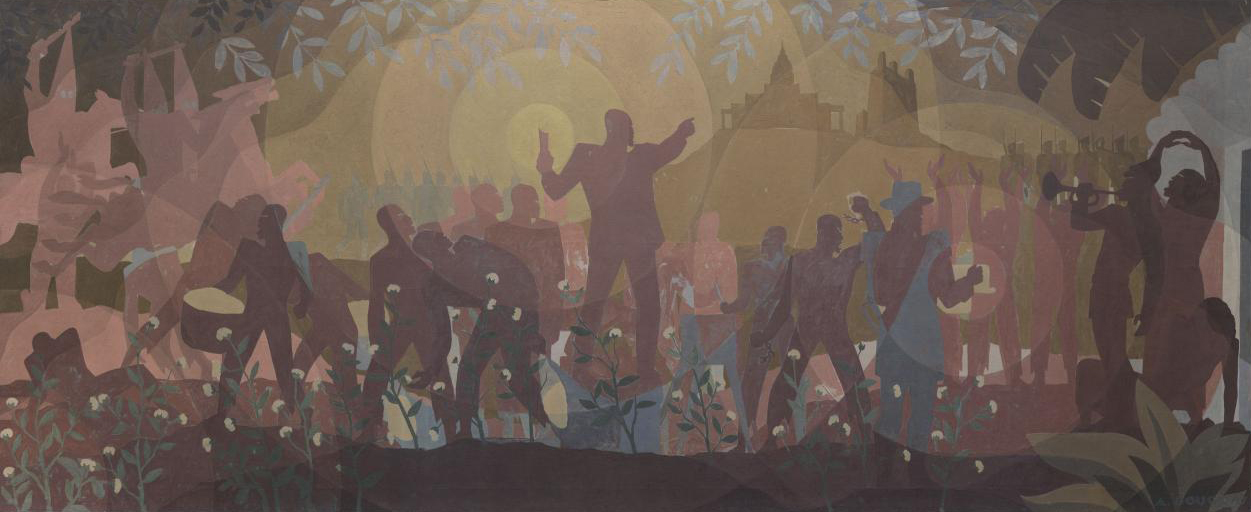
His four-panel mural cycle Aspects of Negro Life (1934), commissioned for the Countee Cullen Branch of the New York Public Library in Harlem, is widely regarded as his masterwork. Moving from African origins through slavery, Reconstruction, and the Great Migration into the promise of the Harlem Renaissance, the series functions as both a history painting and a declaration of cultural identity. It remains one of the most ambitious works of public art produced in 20th-century America.
Aaron Douglas (1899–1979), Aspects of Negro Life: From Slavery to Reconstruction, 1934, Art and Artifacts Division, Schomburg Center for Research in Black Culture. Source: New York Public Library
Other major commissions followed: mural cycles for Fisk University’s library in Nashville (1930) and Bennett College in Greensboro, North Carolina (1931), painted for two of the country’s most important Historically Black Colleges and Universities. Into Bondage (1936), part of a series created for the Texas Centennial Exposition, is now in the permanent collection of the National Gallery of Art in Washington, D.C., institutional recognition that situates Douglas firmly within the canon of American art history. His works are also held by the Smithsonian American Art Museum, the Whitney Museum of American Art, and the Schomburg Center for Research in Black Culture.
Beyond painting, Douglas was a prolific illustrator whose work appeared in Vanity Fair, Theatre Arts Monthly, the NAACP’s journal The Crisis, and the National Urban League’s Opportunity magazine. He illustrated landmark texts of the Harlem Renaissance, including Alain Locke’s The New Negro (1925) and James Weldon Johnson’s God’s Trombones (1927), and collaborated closely with writers including W.E.B. Du Bois and Langston Hughes. In 1935, he helped found the Harlem Artists Guild — serving as its first president — an organization that created a vital professional network for Black artists working in New York during one of the most challenging periods in American history.
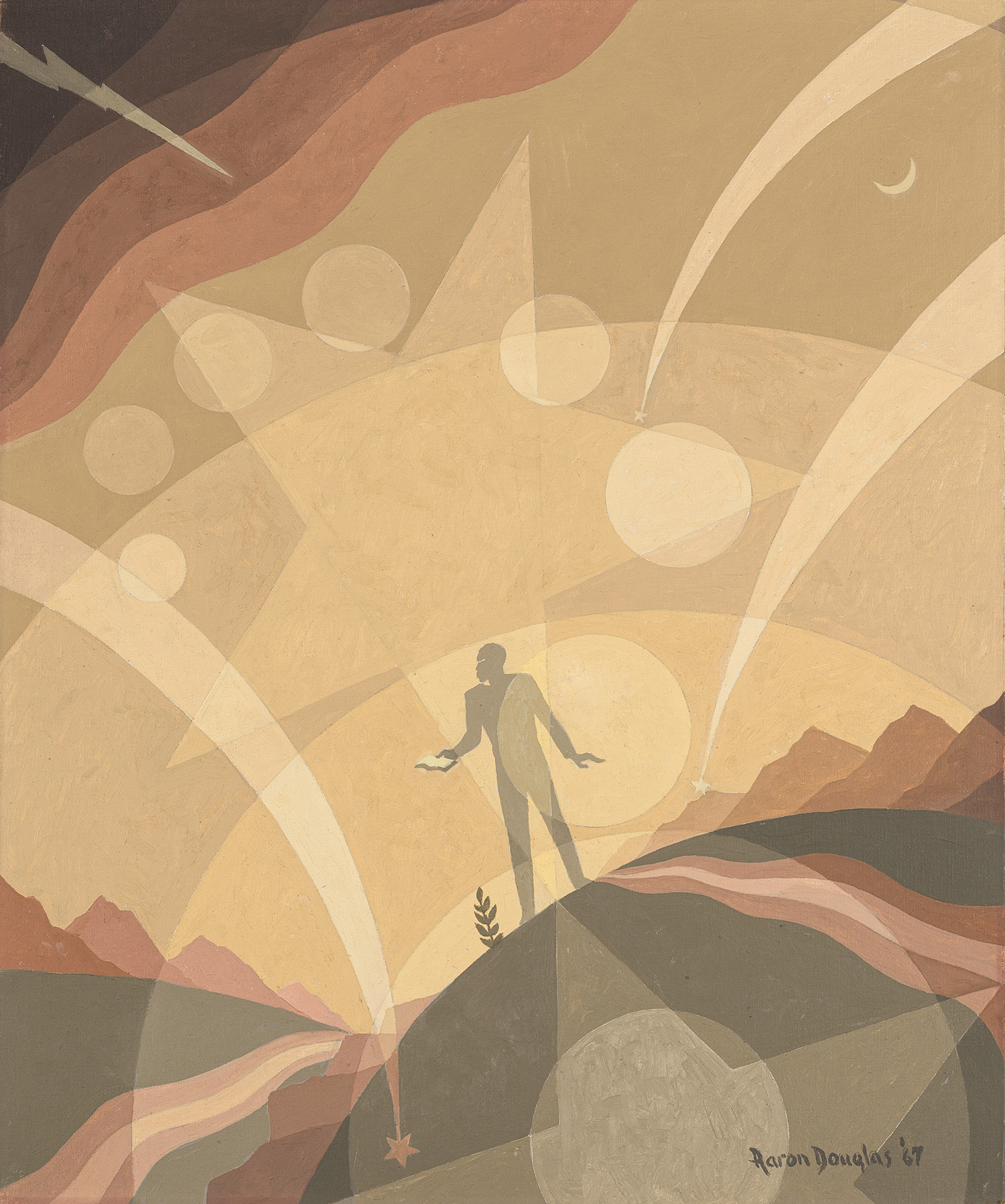
Aaron Douglas, Inspiration, 1967, oil on canvas panel, 30″ × 25″. Smithsonian American Art Museum
In 1939, Douglas transitioned to education, joining the faculty at Fisk University. He would go on to found and chair the university’s Art Department in 1944, a role he held until his retirement in 1966. His influence on subsequent generations of African American artists, including Jacob Lawrence, who absorbed Douglas’ use of bold color fields, and Kara Walker, whose silhouetted figures carry forward his visual legacy, is a measure of just how far his impact reaches.
Aaron Douglas Prints, Paintings, & Works on Paper: A Collector’s Overview
For collectors looking to acquire art by Aaron Douglas, the market offers several distinct entry points.
Oils on canvas and board represent the top tier of the market and the rarest category. These works — particularly those that showcase his characteristic silhouetted figures, layered light effects, and signature palette — command the strongest prices at auction. The auction record for a Douglas painting stands at $500,000, achieved at Swann Auction Galleries in 2008 for Building More Stately Mansions. Works from his peak Harlem Renaissance period (1920s–1930s) attract the most sustained collector interest, though accomplished late-career paintings also perform well.
Works on paper and prints offer a more accessible entry into the market. Douglas produced a body of etchings and aquatints, often in small editions, that allow collectors to acquire his draftsmanship and compositional intelligence at a lower price point than his oils. Artist proofs and documented impressions with clear provenance are especially sought after.
Illustrations and published works — original drawings made for books and periodicals represent another collecting category, often surfacing at auction alongside Harlem Renaissance literature and archival material.
Across all fine art departments, provenance connected to the Harlem Renaissance community, documented exhibition history, and strong signature placement all contribute meaningfully to value.
Aaron Douglas at Clars Auctions
Clars Auctions has handled Aaron Douglas’ work at auction, and we understand both the significance of these pieces and what collectors are looking for when they come to market. Among the works we have offered is an Untitled oil on canvas (circa 1955, 22″ × 44″, signed lower left), a large-format late-career painting that demonstrates Douglas’ sustained command of abstracted landscape, figure composition, and the interplay of color and light that defines his best work. The painting was offered in our Important Summer Fine Art Sale, with an estimate of $10,000–$20,000 (sold for $10,710), and drew serious collector interest.
For Buyers
Authentic Aaron Douglas paintings, prints, and works on paper appear at auction far less often than collector demand would suggest. When they do, they rarely last. If you are building a collection in American modernism or Harlem Renaissance art, we recommend reviewing our current catalog and auction calendar to see when a Douglas work enters one of our sales.
If you own a work by Aaron Douglas, whether a painting, print, illustration, or work on paper, Clars Auctions is well-positioned to help you understand its value and bring it to the right buyers. Our fine art specialists offer professional appraisals for fair market, insurance, and estate purposes, and our established reputation in American and African American art means your consignment reaches a serious, targeted collector base. We work with individual sellers, estate executors, fiduciaries, and institutions, and we handle every step of the process with care. You may also contact us or visit us at our auction house in Oakland if you have any questions.
Annie Leibovitz began her artistic career at the San Francisco Art Institute in the late 1960s, where she originally studied painting but was inspired to change her focus to photography.
Marion Kavanaugh Wachtel beautifully captures the vibrant transformation of the leaves in the foothills of California.
Artist Spotlight
Fine Art
Artist Spotlight: Joan Brown
Artist Spotlight
Modern + Contemporary Art
This May at Clars we are excited to feature a selection of modern and contemporary artwork that will undoubtably appeal to each and every collector. For fans of the Bay Area Figurative Movement, we are highlighting two works on paper by celebrated multimedia artist Joan Brown (American, 1938–1990).
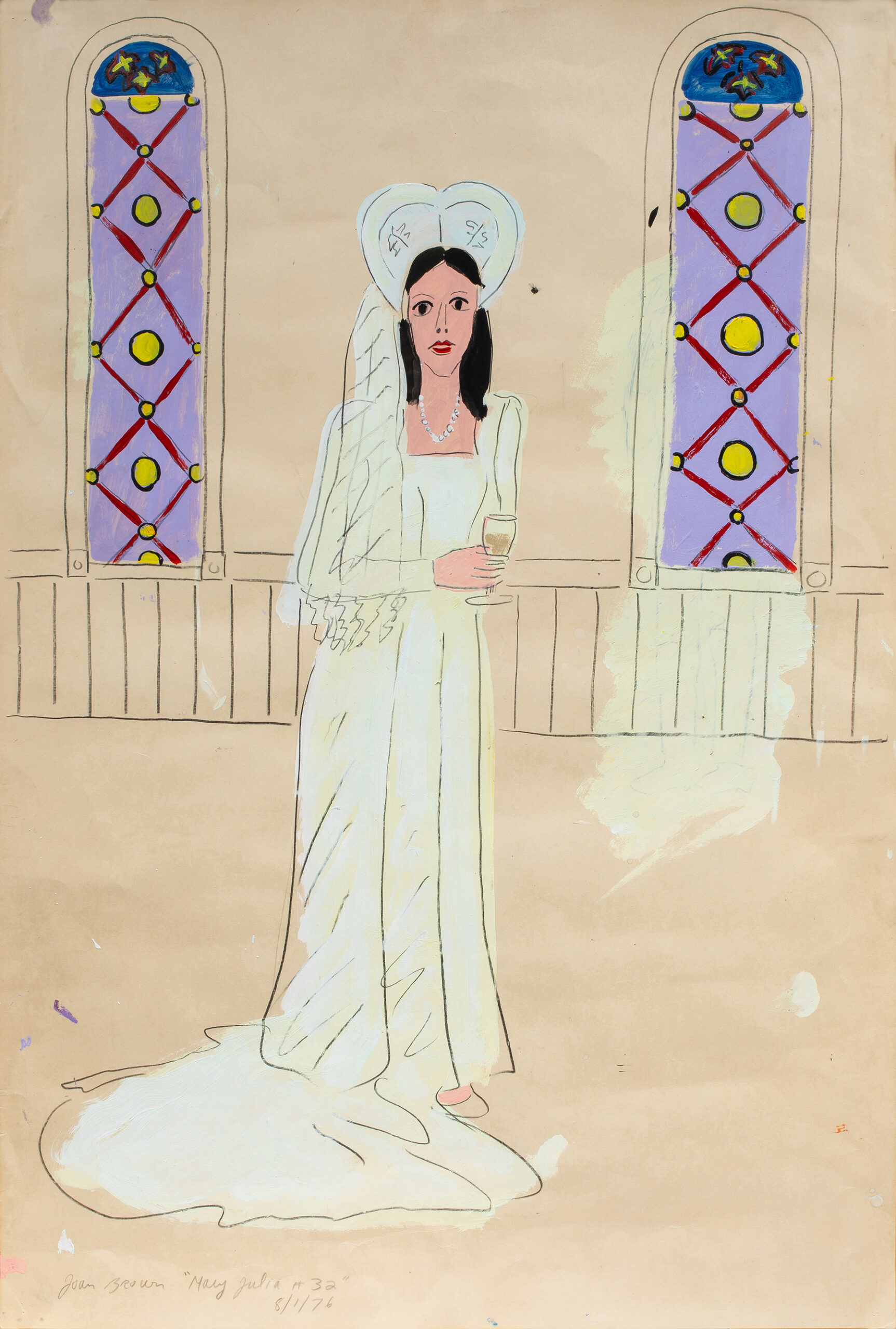
Brown was born in San Francisco and continued to work in the area for her entire life, creating paintings, sculptures, and works on paper that celebrated the Bay Area as much as her own inner life. During her prolific career, Brown evolved stylistically from abstract expressionism to folk art inspired figurative painting and became involved in the highly influential Bay Area Figurative Movement. Brown was married for a period to a fellow member of the movement, Manuel Neri, who introduced her to the model Mary Julia Klimenko, Brown’s muse for the series that includes the two pieces at Clars this month. These two acrylic and charcoal compositions are titled Mary Julia #32, estimated at $8,000–$12,000, and Mary Julia #33, estimated at $8,000–$12,000, and each depicts the subject in two strikingly different settings.
Joan Brown (American, 1938–1990), Mary Julia #32, 1976, acrylic and graphite on paper, 36″ x 24″. Estimate: $8,000–$12,000
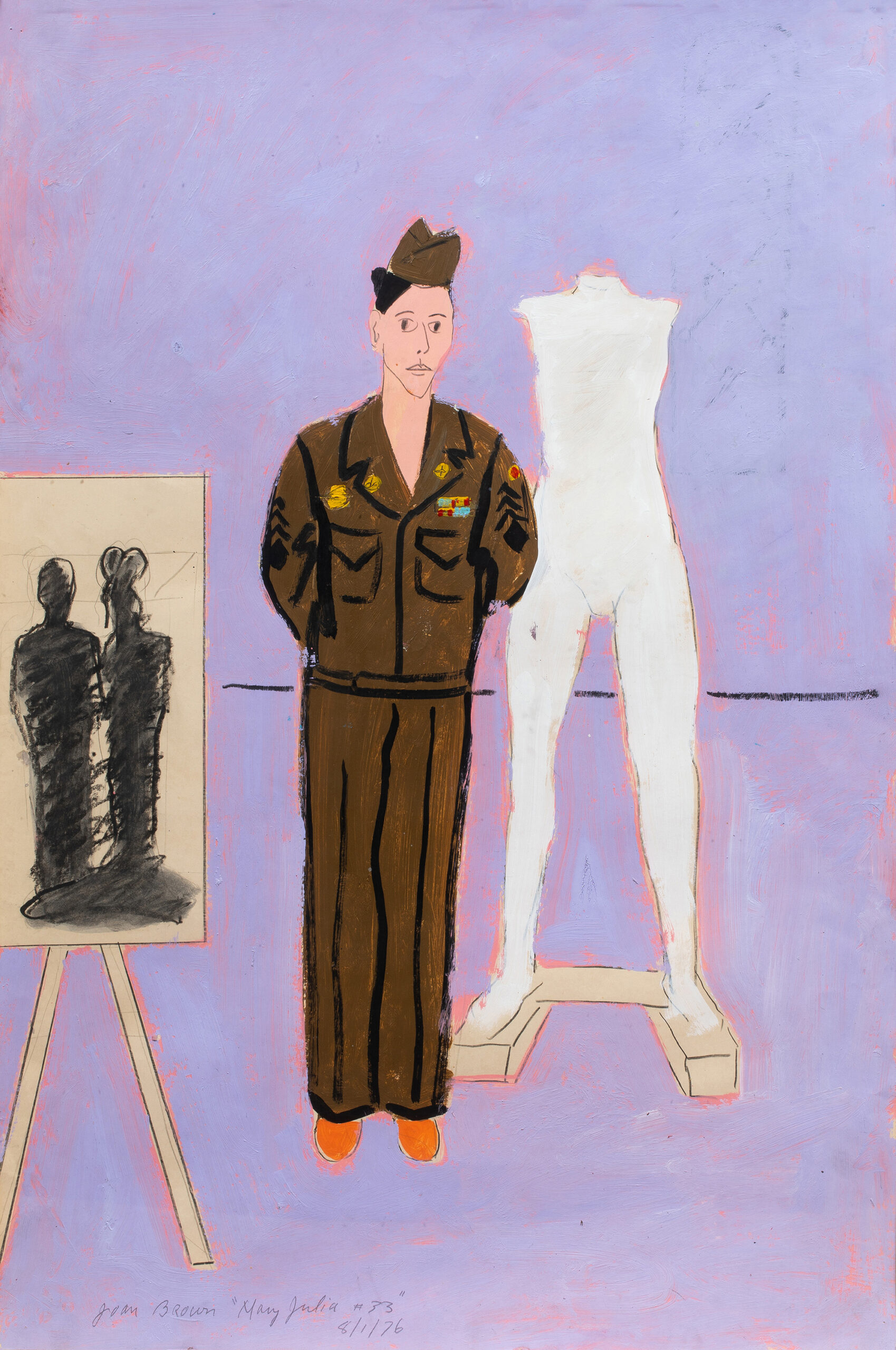
Mary Julia #32 is shown alone in an austere space, likely a chapel, with two narrow stained-glass windows behind her. Her dark hair is topped with a veil that recalls medieval tastes, and her white gown indicates that it is the day of her wedding. She stares wide-eyed at the viewer, holding a champagne glass. Mary Julia #33 is dressed in a green military uniform with her arms behind her back. Next to her is a headless white sculpture, perhaps depicting herself, and a picture of two blackened figures sitting on an easel. Each work is done in Brown’s instantly recognizable faux-naif style, with her signature splashes of color. The two pair themselves with the use of lavender on the wall and windows.
Joan Brown (American, 1938–1990), Mary Julia #33, 1976, acrylic, charcoal, and graphite on paper, 36″ x 24″. Estimate: $8,000–$12,000
Annie Leibovitz began her artistic career at the San Francisco Art Institute in the late 1960s, where she originally studied painting but was inspired to change her focus to photography.
This May 15th, Clars is excited to offer an outstanding oil on canvas painting by artist Raimonds Staprans.
Artist Spotlight
Modern + Contemporary Art
Artist Spotlight: Dia Al-Azzawi
Artist Spotlight
Modern + Contemporary Art
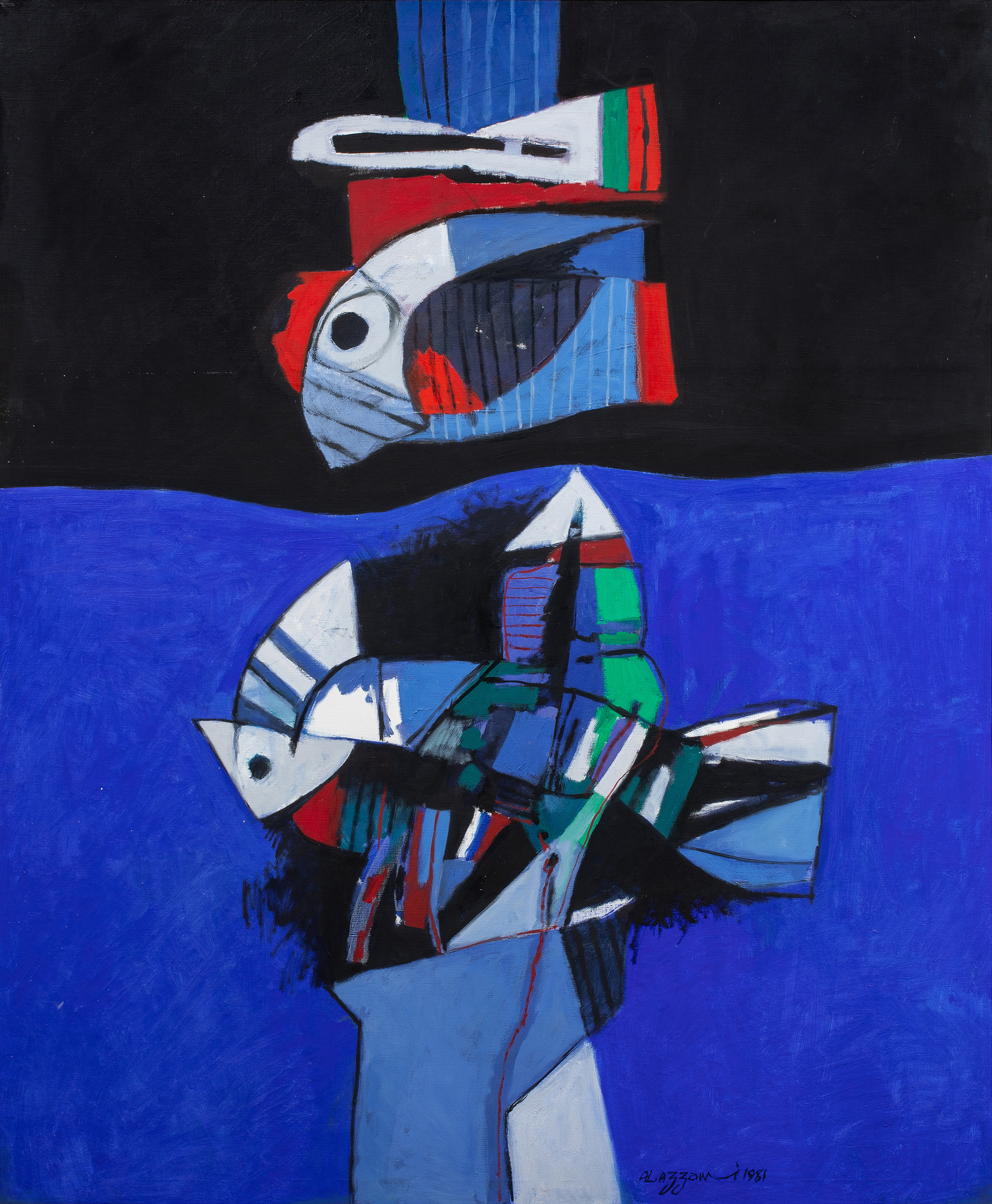
An outstanding piece in the May auction is an oil on canvas painting by Iraqi artist Dia Al-Azzawi (b. 1939). Al-Azzawi studied art in Baghdad, taking inspiration from ancient Middle Eastern mythology as well as Islam and Arabic culture, and worked in the city throughout the mid-20th century.
Al-Azzawi eventually moved out of Iraq in the 1970s and began working abroad, using painting as an outlet for feelings of despair he felt seeing the destruction of his homeland during the wars that plagued the country during the later 20th century. Now living between London and Dubai, Al-Azzawi maintains his status as one of the foremost globally successful Arab artists, and an influential icon in his home country.
Dia al-Azzawi (Iraqi, b. 1939), Sleeping Bird, 1981, oil on canvas, 47.25″ x 39.38″ (120 x 100 cm). Sold: $72,050
The painting in our May Modern + Contemporary Fine Art Auction is titled Sleeping Bird, estimated at $15,000–$20,000. In its abstraction, the hovering head of a beaked bird appears above an assortment of interpretive shapes below, faithful to distinctive Cubist style and vibrant color palette.
Annie Leibovitz began her artistic career at the San Francisco Art Institute in the late 1960s, where she originally studied painting but was inspired to change her focus to photography.
This May 15th, Clars is excited to offer an outstanding oil on canvas painting by artist Raimonds Staprans.
Artist Spotlight
Modern + Contemporary Art
Artist Spotlight: Raimonds Staprans
Artist Spotlight
Modern + Contemporary Art
This May 15th, Clars is excited to offer an outstanding oil on canvas painting by Latvian American artist Raimonds Staprans (b. 1926) in our Modern + Contemporary Fine Art Auction.
Upon moving to the San Francisco Bay Area in the 1950s, Staprans was quickly adopted by the art community in his chosen home and remains one of the foremost representatives of post-war California painting nationwide. Staprans is known for his large swaths of bright color, often playing with natural light and the perception of shape and texture, and his understated treatment of subject.
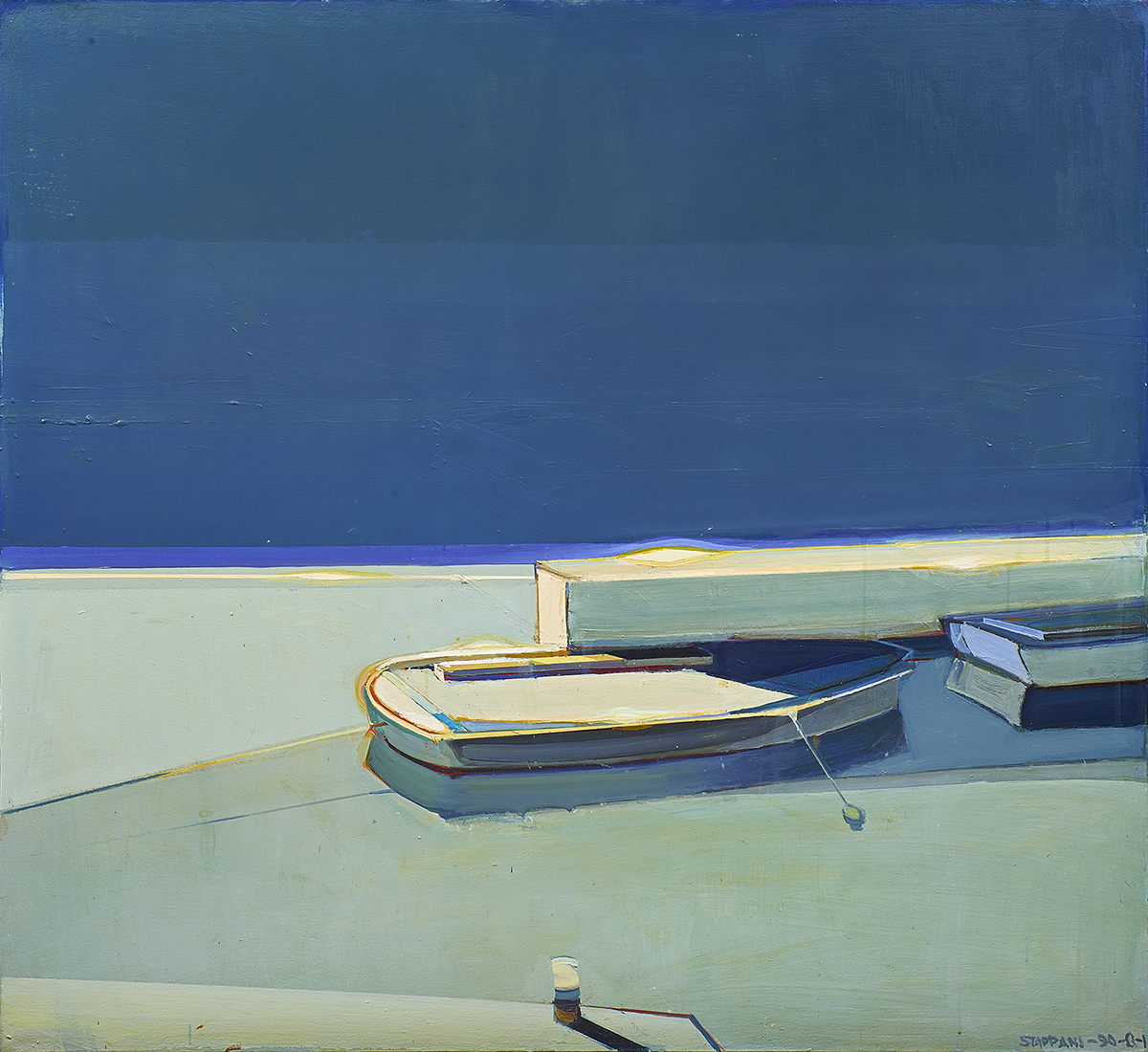
Raimonds Staprans (American/Latvian, b. 1926), Blue Boats, 1990, oil on canvas, 44″ x 48″. Sold: $187,500
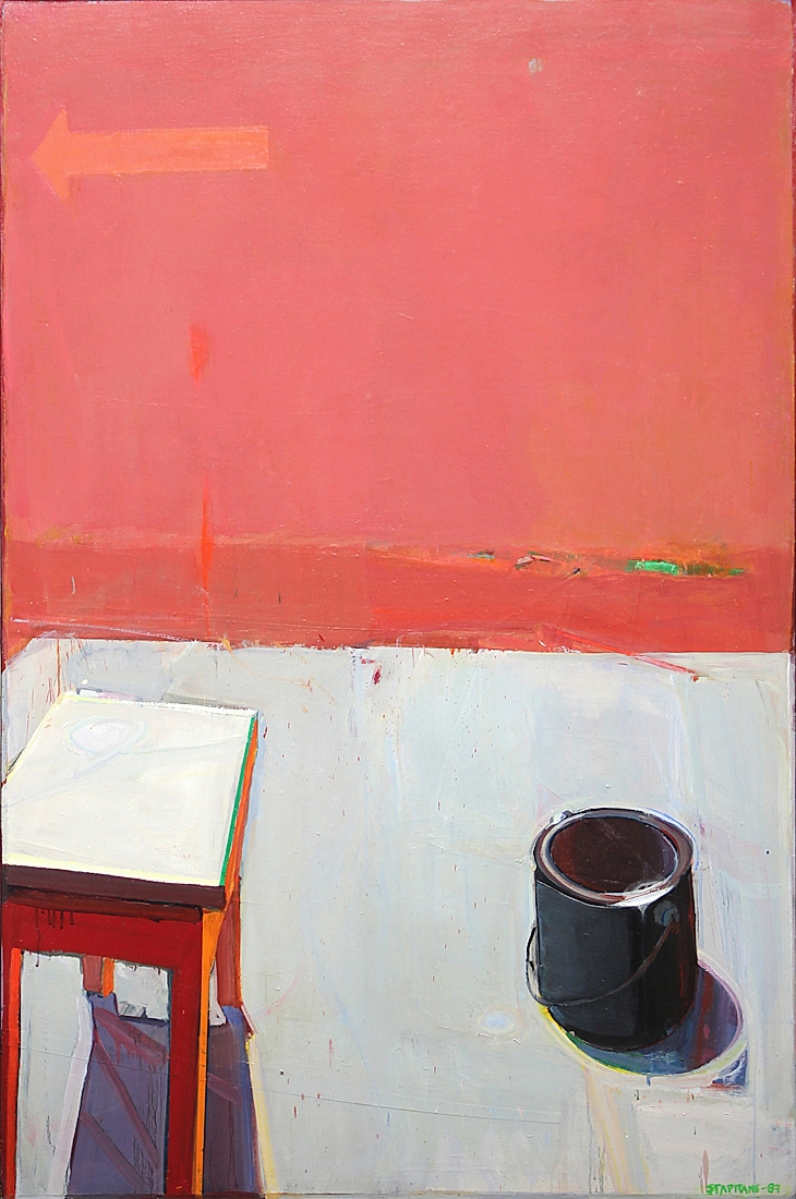
Current trends in the market show that the highly saturated paintings that Staprans perfected in the late 1980s and 1990s are increasingly popular with collectors. Clars has been successful with several of these pieces in the last five years, including a 1987 oil on canvas titled, Still Life with Red Piano Stool, which sold well over its estimate at $147,600 in 2020, and Blue Boats, a 1990 painting that sold for $187,500 in 2022. Still life depictions of food are among the most recognizable of Staprans’ motifs. Staprans’ highest record price was realized in 2023 for a 1995 still life depicting oranges, done in a vibrantly warm palette that is strikingly similar to the piece up for auction at Clars this May.
Raimonds Staprans (American, b. 1926), Still Life with Red Piano Stool, 1987, oil on canvas, 64″ x 42″. Sold: $147,600
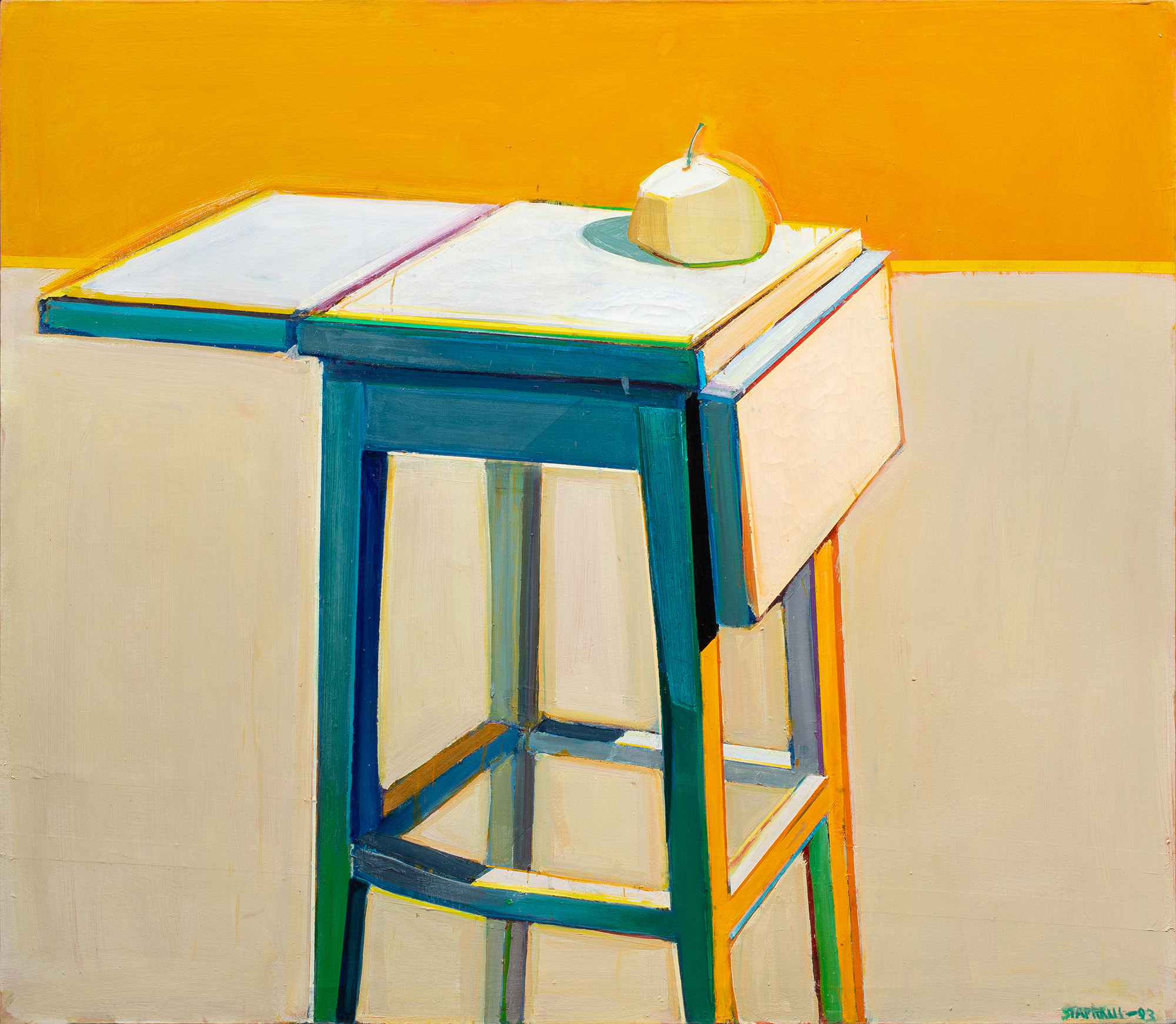
The scene takes place in a space unmarked by identifying objects, furnished with a stool-like drop-leaf table. The table’s edges and sides are traced with prismatic colors in a manner that leaves the viewer questioning if the color is painted on the posts and boards, or if the unseen sun is playing tricks on our eyes. The top of the table appears to be doused with direct sunlight, bright white and glowing against the orange background. To the viewer’s right, the sides of the table’s legs are cast in a sunset glow the same tangerine shade as the background. Sitting atop the table is a peeled apple, its sides angled and smoothed with a paring knife. The fruit casts a half-moon shadow that points toward the open leaf of the table and is echoed on each stretcher below.
To be offered May 15th: Raimonds Staprans (American/Latvian, b. 1926), The Mid Summer Drop-Leaf Table, 1993, oil on canvas, 48″ x 42″. Sold: $189,000
This work, titled The Mid Summer Drop-Leaf Table (estimated at $60,000–$90,000), showcases Staprans’ skill in using color to portray light, perspective, and a specific atmosphere. The tones chosen in this composition evoke the warmth of the summer months, and the slant of the dazzling sunshine on the table and fruit leave us wondering if this is the end of a late-evening garden party, where a table full of fresh fruit has dwindled to a lone apple and the leaves are dropped one by one. This outstanding example of Staprans’ later work is a celebration of color and light, an ode to atmosphere, and will be a significant addition to any collection.
Raimonds Staprans (American/Latvian, b. 1926), The Black Boat, 1963, oil on canvas, 22″ x 25″. Sold: $18,900
Annie Leibovitz began her artistic career at the San Francisco Art Institute in the late 1960s, where she originally studied painting but was inspired to change her focus to photography.
Al-Azzawi studied art in Baghdad, taking inspiration from ancient Middle Eastern mythology as well as Islam and Arabic culture.
Artist Spotlight
Modern + Contemporary Art
Artist Spotlight: Marion Kavanaugh Wachtel
Artist Spotlight
Fine Art
This March 21st at Clars Auctions, we will be featuring a curated assortment of artwork from a wide range of periods and locales.
From our own state of California, we have an oil on canvas by plein air painter Marion Kavanaugh Wachtel (American, 1876–1954). Wachtel was born in Milwaukee, Wisconsin and studied in Chicago before moving to California, where she studied under Scottish American master landscapist William Keith.
Keith’s influence coupled with her new surroundings inspired Wachtel to move away from portraiture and embrace landscape painting, focusing her attention on the mountains, coasts, and foliage of southern California. The painting in this month’s sale is titled Autumn, Trabuco Mountains, California, (estimate: $8,000–$12,000) and depicts the leaves changing color amidst the peak on the border of Orange and Riverside Counties.
Marion Kavanaugh Wachtel (American, 1876–1954), Autumn, Trabuco Mountains, California, oil on canvas, 26″ x 30.5″. Estimate: $8,000–$12,000
Annie Leibovitz began her artistic career at the San Francisco Art Institute in the late 1960s, where she originally studied painting but was inspired to change her focus to photography.
Clars’ Important Fine Art Auction on May 15th presents an exceptional selection of artworks by celebrated artists.
Fine Art
Highlights
Artist Spotlight: Andy Warhol
Artist Spotlight
Modern + Contemporary Art
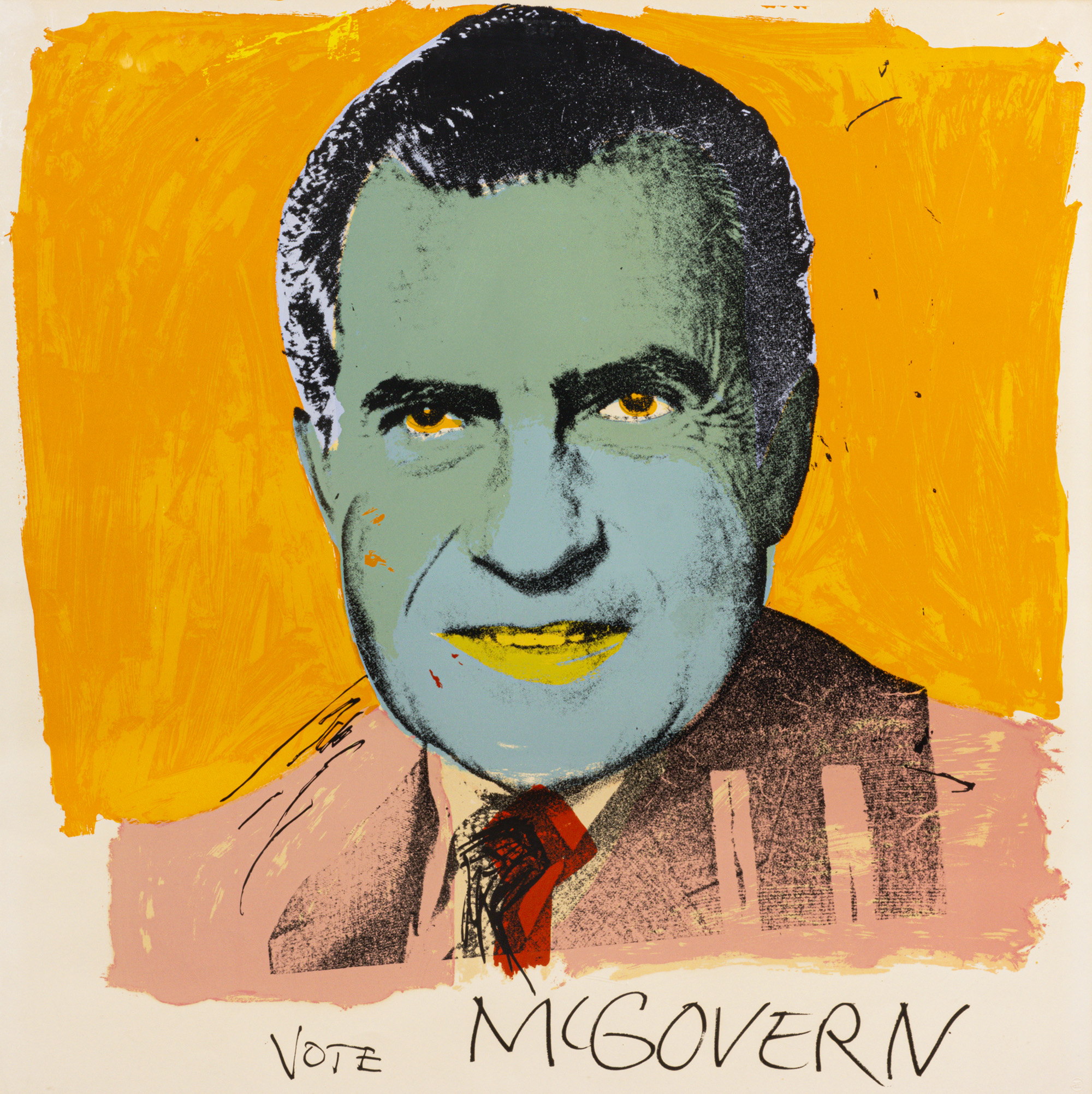
Our Modern + Contemporary Fine Art Auction on February 20th will feature many exceptional works by renowned artists. One of the standout pieces is Vote McGovern (1972), an iconic screenprint by Andy Warhol, estimated $30,000–$50,000.
This politically charged work from 1972 reinterprets a photograph of Richard Nixon, using a vivid color palette that references First Lady Pat Nixon’s dress. The unsettling portrait, created to support George McGovern’s presidential campaign, is a striking example of Warhol’s ability to blend art with political activism.
Andy Warhol (American, 1928–1987), Vote McGovern, 1972, screenprint, 42″ x 42″. Estimate: $30,000–$50,000
Annie Leibovitz began her artistic career at the San Francisco Art Institute in the late 1960s, where she originally studied painting but was inspired to change her focus to photography.
Al-Azzawi studied art in Baghdad, taking inspiration from ancient Middle Eastern mythology as well as Islam and Arabic culture.
Artist Spotlight
Modern + Contemporary Art
Artist Spotlight: John Alexander
Artist Spotlight
Modern + Contemporary Art
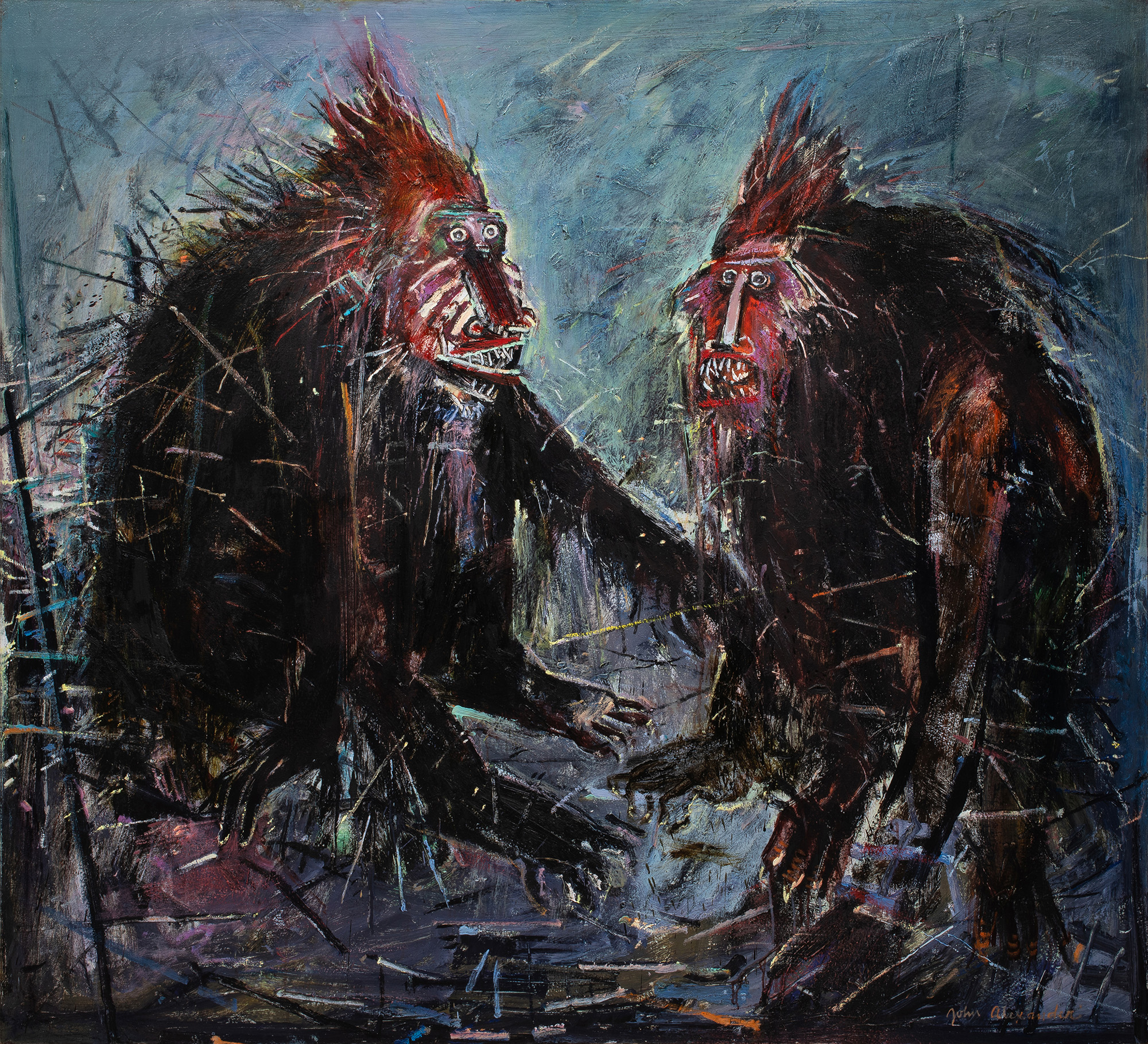
Our Modern + Contemporary Fine Art Auction on February 20th will feature many exceptional works by renowned artists. One of the standout pieces is The Summit Conference (1986), an oil painting by John Alexander estimated at $30,000–$50,000.
Known for his atmospheric depictions of the Gulf Coast’s bayou landscapes, Alexander infuses his paintings with surrealist elements, such as skeletons in formal wear and masked figures. The work on offer features two baboons facing off against one another, with intense, expressive brushstrokes suggesting a deeper political commentary during the tense era of the Reykjavik Summit talks between Ronald Reagan and Mikhail Gorbachev.
John Alexander (American, b. 1945), The Summit Conference, 1986, oil on canvas, 60″ x 66″. Estimate: $30,000–$50,000
Annie Leibovitz began her artistic career at the San Francisco Art Institute in the late 1960s, where she originally studied painting but was inspired to change her focus to photography.
Al-Azzawi studied art in Baghdad, taking inspiration from ancient Middle Eastern mythology as well as Islam and Arabic culture.
Artist Spotlight
Modern + Contemporary Art
Artist Spotlight: Marc Chagall
Artist Spotlight
Modern + Contemporary Art
Marc Chagall, revered worldwide for his ability to blend diverse artistic techniques into a distinct, dreamlike style, is particularly known for integrating his Jewish heritage into his art.
Chagall‘s vivid, often surreal compositions are alive with color, and his use of blue — which has been interpreted as symbolizing spirituality and divinity — is particularly notable. Drawing from his personal experiences and Jewish folk traditions, Chagall’s works come alive with a sense of movement and emotion, making them both fantastical and deeply personal.
Among the highlights of the auction are two rare works on paper by Chagall, L’hiver: Procession de Noël (Les quatre saisons) (1974) and Le Dimanche (circa 1939), each carrying an estimate of $300,000–$500,000.
Marc Chagall (French/Belarusian, 1887–1985), L’Hiver: Procession de Nöel – Les Quatre Saisons (Winter: Christmas Procession – The Four Seasons), 1974, gouache, tempera, pastel, India ink, colored pencils and graphite on paper, 63 cm x 90 cm (24.80″ x 35.43″). The authenticity of this work has been confirmed by the Marc Chagall Committee. Estimate: $300,000–$500,000 (USD)
In L’hiver, Chagall presents an enchanting scene filled with angelic figures in the sky, joyful dancers, a fantastical half-human, half-hen figure with her young, and a procession of Christmas revelers. This eclectic composition echoes Chagall’s 1974 mosaic Four Seasons in Chicago’s Chase Tower, where he similarly fused vibrant, animated figures with animals and abstract forms. This work exemplifies Chagall’s later style, where his compositions often feel
spontaneous and unrestrained.
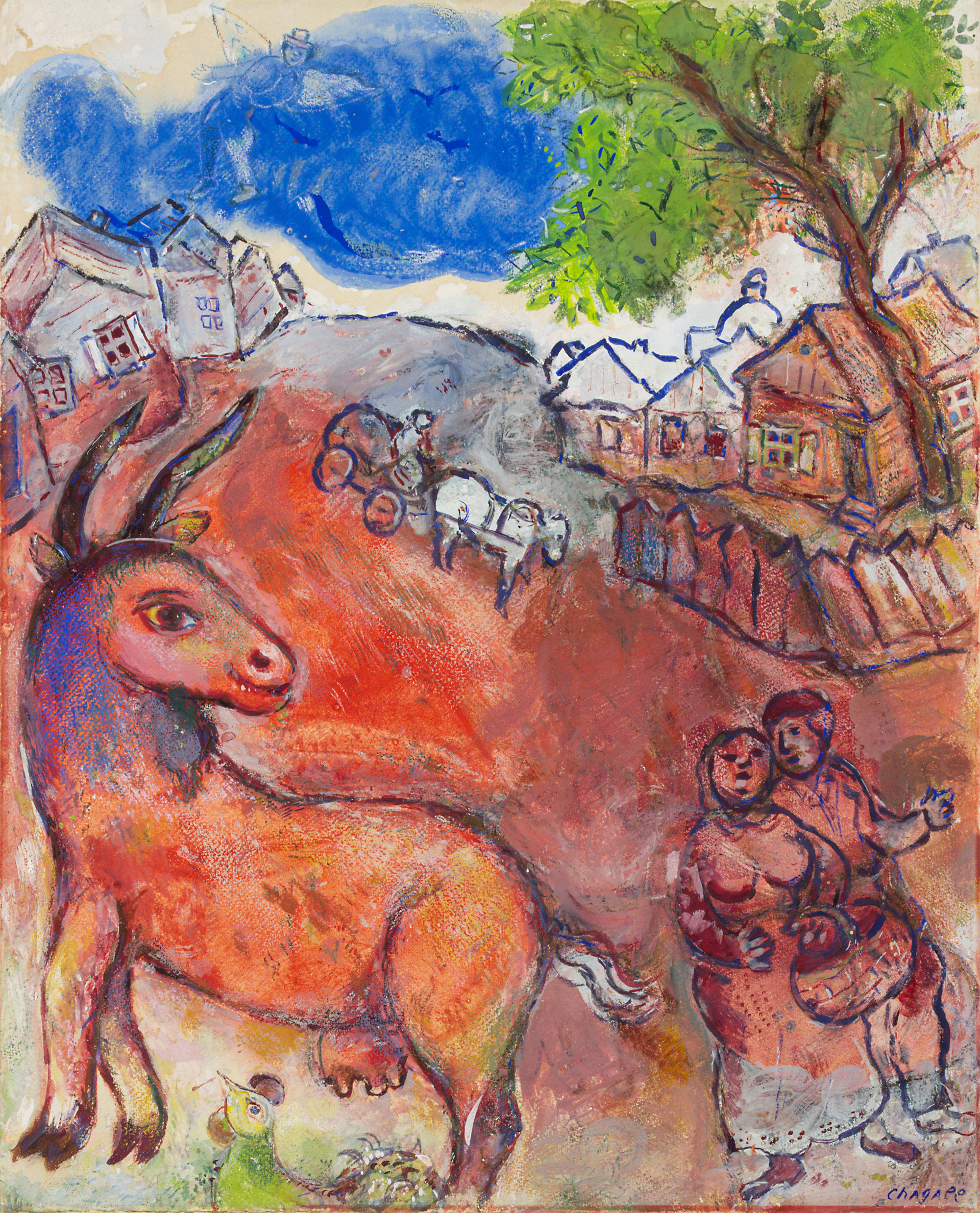
Marc Chagall (French/Belarusian, 1887–1985), Le dimanche (Sunday), circa 1939, pastel and gouache on paper, 68 cm x 52.7 cm (26.77″ x 20.75″). The authenticity of this work has been confirmed by the Marc Chagall Committee. Estimate: $300,000–$500,000 (USD)
Le Dimanche, created around 1939, depicts a tranquil rural scene with a couple strolling past a goat and a chicken. The horned goat, a recurring symbol in Chagall’s work, is often linked to his childhood in the shtetl and is sometimes interpreted as an allegory for the artist himself. The piece also reflects Chagall’s connection to the innocent life he left behind, likely providing him with solace during the uncertain period of World War II. Both of these works, created with
gouache, pastel, and mixed media, are rich in color and texture, showcasing Chagall’s
masterful use of materials.
Annie Leibovitz began her artistic career at the San Francisco Art Institute in the late 1960s, where she originally studied painting but was inspired to change her focus to photography.