The Artist Who Defined the Visual Identity of the Harlem Renaissance
When Aaron Douglas arrived in New York City in 1925, he had planned to keep moving, and Paris was the destination, as it was for so many artists of his generation. He never made it. What he found in Harlem was something more urgent: a cultural awakening in full swing, and a community of writers, thinkers, and artists who recognized in him exactly what they needed. Douglas stayed and, in doing so, became the defining visual chronicler of the Harlem Renaissance.
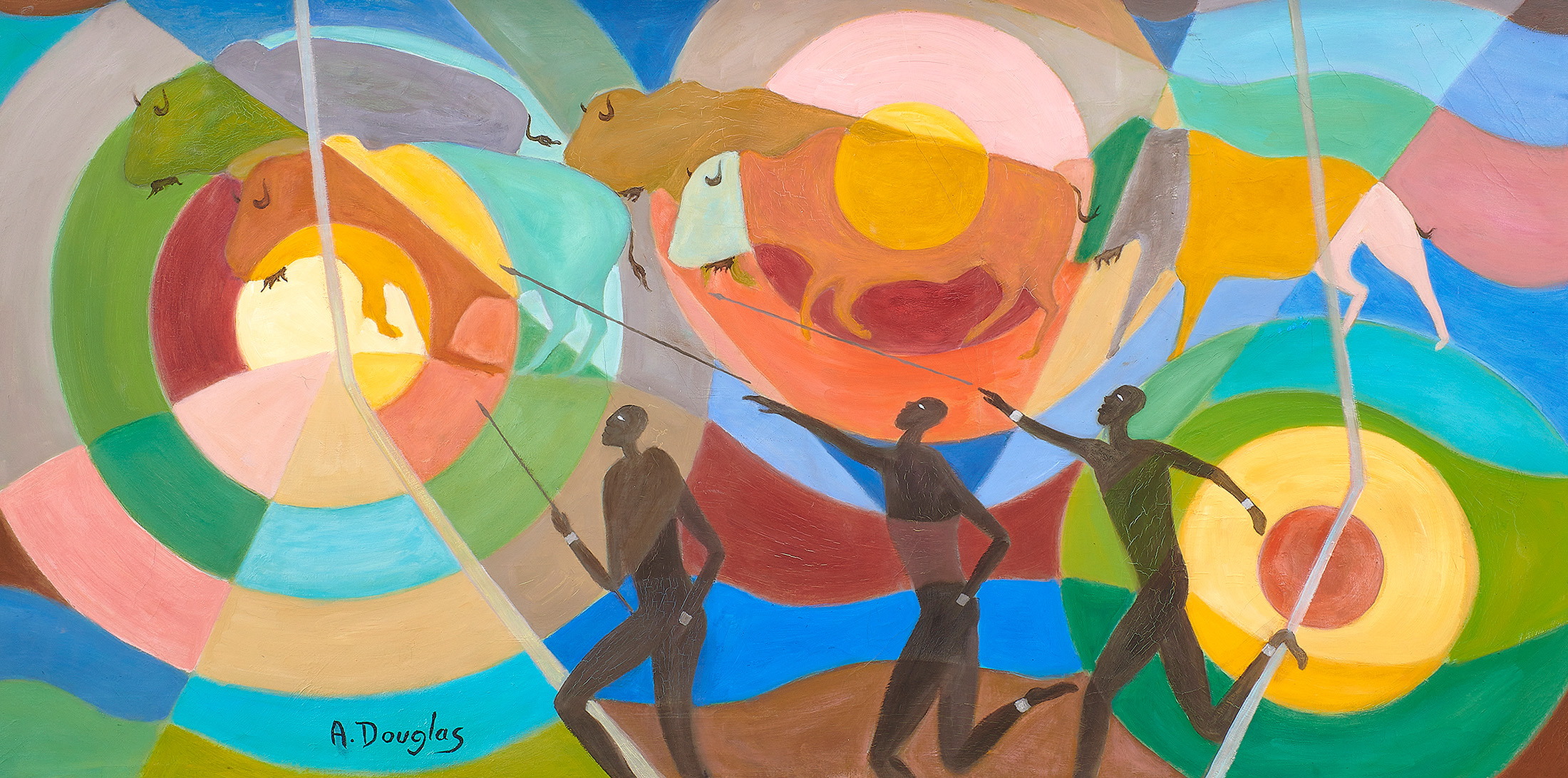
Sold: $10,710
Born in Topeka, Kansas, on May 26, 1899, Douglas came to art with both formal training and personal conviction. He earned his fine arts degree from the University of Nebraska in 1922, taught in Kansas City, and arrived in Harlem already serious about his craft. Under the mentorship of German portraitist Winold Reiss, he was pushed toward something more daring, a visual language rooted in African artistic traditions that could speak directly to the Black American experience. Douglas embraced the challenge fully, and what emerged was a style unlike anything in American art at the time.
A Style Built to Last
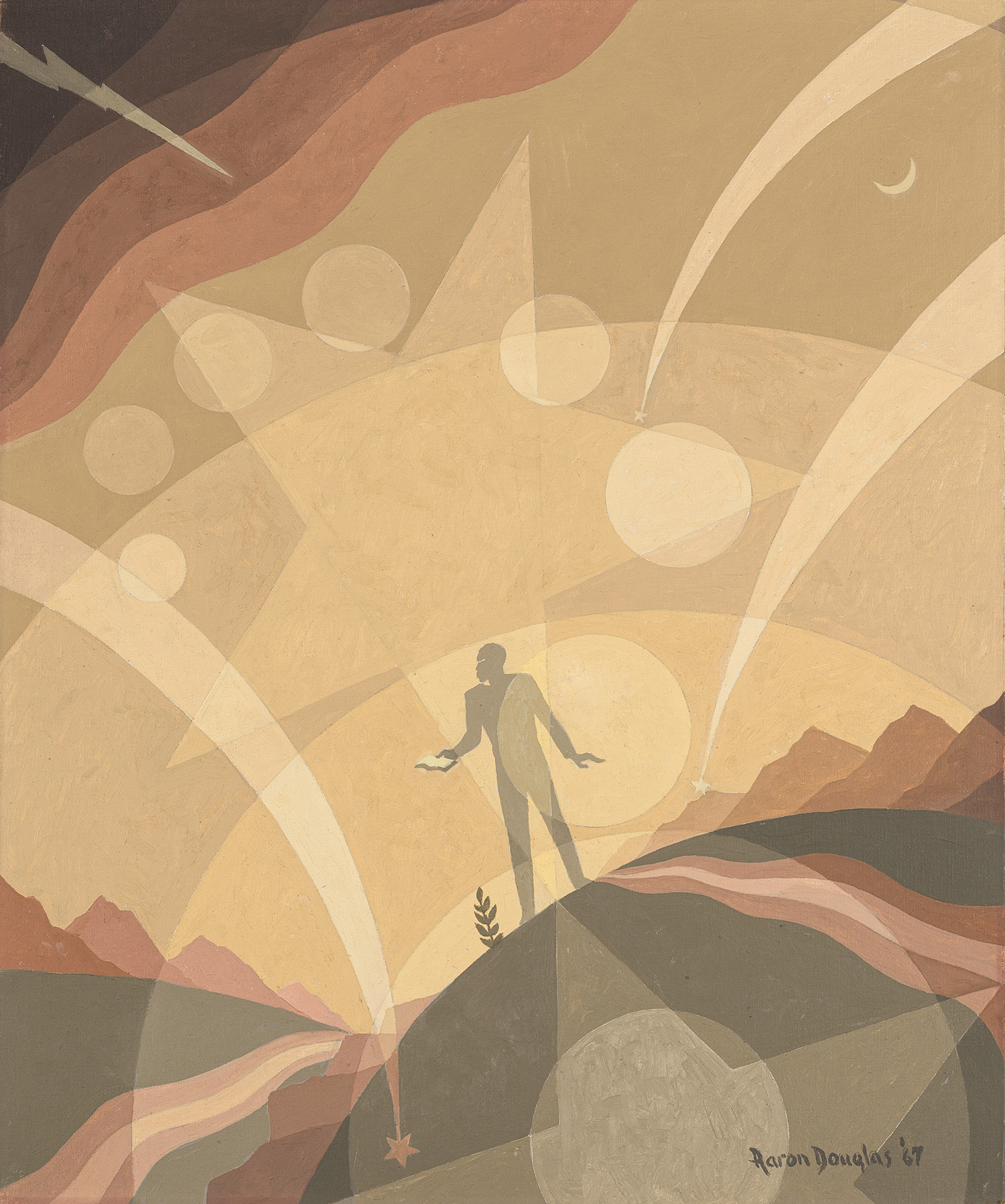
What makes Aaron Douglas’ paintings immediately recognizable is the deliberate tension between simplicity and complexity. His figures are rendered as flat silhouettes, stripped of individual features, yet radiating collective power. He layered concentric rings of light behind his subjects, a signature compositional device that gave his scenes an almost spiritual luminosity. Color was handled with restraint: muted earth tones, dusky blues and greens, punctuated by sharp gradients that suggested both sunlight and searchlights.
These choices weren’t aesthetic accidents. Douglas was synthesizing multiple art historical traditions simultaneously — the geometric rigor of Cubism, the decorative clarity of Art Deco, and the narrative conventions of ancient Egyptian wall painting — and filtering them through the rhythms of jazz, the imagery of the African continent, and the daily realities of Black life in America. The result was a visual vocabulary that felt both ancient and completely modern. It became, as scholars have noted, the aesthetic signature of the Harlem Renaissance itself.
His figures inhabit two worlds with equal fluency. In some works, they move through abstracted African landscapes, spear in hand, surrounded by dense foliage, beneath vast skies. In others, they navigate the urban North: playing brass instruments in jazz clubs, operating industrial machinery, marching against city skylines. Across both settings, the message is the same: people with deep roots, in motion, asserting their place in history.
Aaron Douglas’ Most Significant Accomplishments
Douglas was not simply a studio painter. He was a public artist in the fullest sense, and his most celebrated works were made for walls, not galleries.
His four-panel mural cycle Aspects of Negro Life (1934), commissioned for the Countee Cullen Branch of the New York Public Library in Harlem, is widely regarded as his masterwork. Moving from African origins through slavery, Reconstruction, and the Great Migration into the promise of the Harlem Renaissance, the series functions as both a history painting and a declaration of cultural identity. It remains one of the most ambitious works of public art produced in 20th-century America.
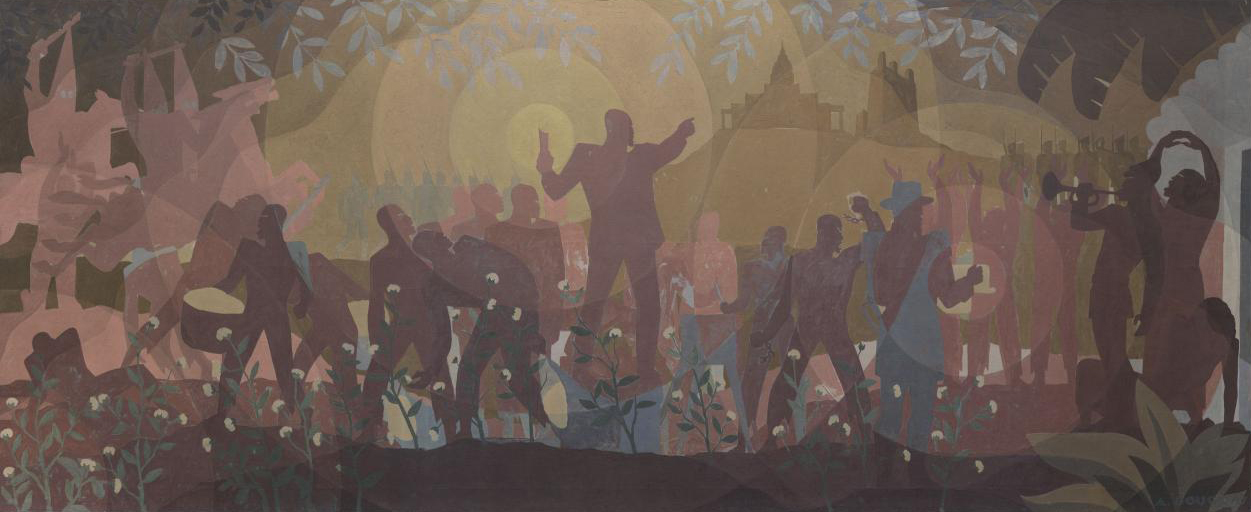
Source: New York Public Library
Other major commissions followed: mural cycles for Fisk University’s library in Nashville (1930) and Bennett College in Greensboro, North Carolina (1931), painted for two of the country’s most important Historically Black Colleges and Universities. Into Bondage (1936), part of a series created for the Texas Centennial Exposition, is now in the permanent collection of the National Gallery of Art in Washington, D.C., institutional recognition that situates Douglas firmly within the canon of American art history. His works are also held by the Smithsonian American Art Museum, the Whitney Museum of American Art, and the Schomburg Center for Research in Black Culture.
Beyond painting, Douglas was a prolific illustrator whose work appeared in Vanity Fair, Theatre Arts Monthly, the NAACP’s journal The Crisis, and the National Urban League’s Opportunity magazine. He illustrated landmark texts of the Harlem Renaissance, including Alain Locke’s The New Negro (1925) and James Weldon Johnson’s God’s Trombones (1927), and collaborated closely with writers including W.E.B. Du Bois and Langston Hughes. In 1935, he helped found the Harlem Artists Guild — serving as its first president — an organization that created a vital professional network for Black artists working in New York during one of the most challenging periods in American history.
Smithsonian American Art Museum
In 1939, Douglas transitioned to education, joining the faculty at Fisk University. He would go on to found and chair the university’s Art Department in 1944, a role he held until his retirement in 1966. His influence on subsequent generations of African American artists, including Jacob Lawrence, who absorbed Douglas’ use of bold color fields, and Kara Walker, whose silhouetted figures carry forward his visual legacy, is a measure of just how far his impact reaches.
Aaron Douglas Prints, Paintings, & Works on Paper: A Collector’s Overview
For collectors looking to acquire art by Aaron Douglas, the market offers several distinct entry points.
Oils on canvas and board represent the top tier of the market and the rarest category. These works — particularly those that showcase his characteristic silhouetted figures, layered light effects, and signature palette — command the strongest prices at auction. The auction record for a Douglas painting stands at $500,000, achieved at Swann Auction Galleries in 2008 for Building More Stately Mansions. Works from his peak Harlem Renaissance period (1920s–1930s) attract the most sustained collector interest, though accomplished late-career paintings also perform well.
Works on paper and prints offer a more accessible entry into the market. Douglas produced a body of etchings and aquatints, often in small editions, that allow collectors to acquire his draftsmanship and compositional intelligence at a lower price point than his oils. Artist proofs and documented impressions with clear provenance are especially sought after.
Illustrations and published works — original drawings made for books and periodicals represent another collecting category, often surfacing at auction alongside Harlem Renaissance literature and archival material.
Across all fine art departments, provenance connected to the Harlem Renaissance community, documented exhibition history, and strong signature placement all contribute meaningfully to value.
Aaron Douglas at Clars Auctions
Clars Auctions has handled Aaron Douglas’ work at auction, and we understand both the significance of these pieces and what collectors are looking for when they come to market. Among the works we have offered is an Untitled oil on canvas (circa 1955, 22″ × 44″, signed lower left), a large-format late-career painting that demonstrates Douglas’ sustained command of abstracted landscape, figure composition, and the interplay of color and light that defines his best work. The painting was offered in our Important Summer Fine Art Sale, with an estimate of $10,000–$20,000 (sold for $10,710), and drew serious collector interest.
For Buyers
Authentic Aaron Douglas paintings, prints, and works on paper appear at auction far less often than collector demand would suggest. When they do, they rarely last. If you are building a collection in American modernism or Harlem Renaissance art, we recommend reviewing our current catalog and auction calendar to see when a Douglas work enters one of our sales.
For Sellers
If you own a work by Aaron Douglas, whether a painting, print, illustration, or work on paper, Clars Auctions is well-positioned to help you understand its value and bring it to the right buyers. Our fine art specialists offer professional appraisals for fair market, insurance, and estate purposes, and our established reputation in American and African American art means your consignment reaches a serious, targeted collector base. We work with individual sellers, estate executors, fiduciaries, and institutions, and we handle every step of the process with care. You may also contact us or visit us at our auction house in Oakland if you have any questions.
New York Public Library
Smithsonian American Art Museum